Swamp Cooler Service guide Last updated October 2026
What it usually means The sound tells you where to look.
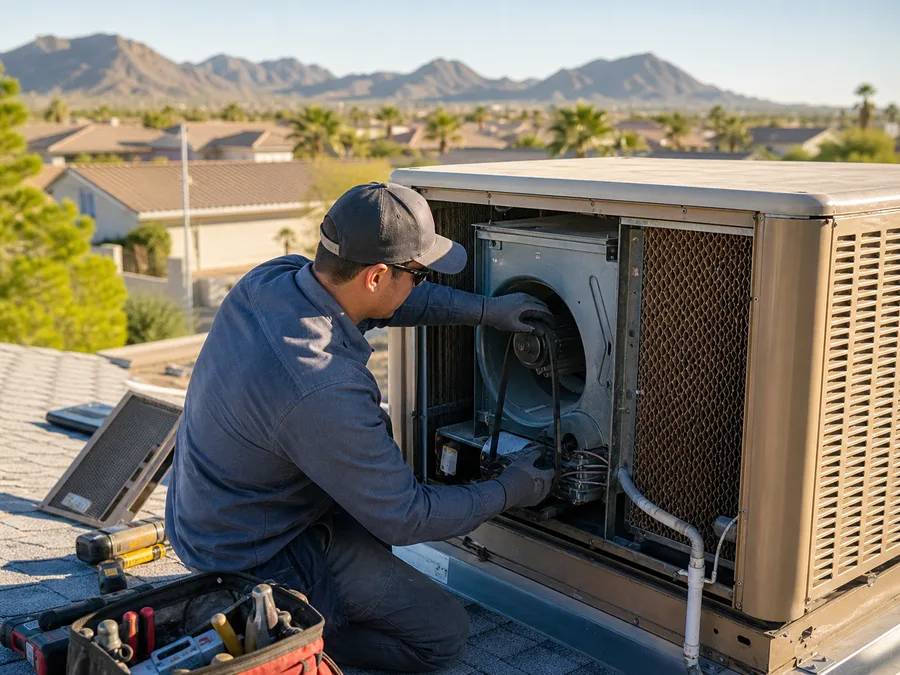
A swamp cooler fan motor drives the blower wheel through a belt. When airflow stops, the problem is usually power, the motor itself, the belt, or the bearings, and each one sounds different at startup.
Likely causes
Six reasons a swamp cooler motor stops working.

No power reaching the motor
A tripped breaker, a switched-off disconnect, a failed wall switch or thermostat, or a loose wire can stop the motor while everything looks normal.
Thermal overload tripped
Most cooler motors shut themselves off when they overheat and restart after cooling down. A motor that keeps cutting out is usually working too hard because of a tight belt, dry bearings, or a failing motor.
Broken or slipping belt
If the motor runs but the blower wheel does not turn, or turns slowly, the belt may be broken, glazed, or too loose. A squeal at startup is a common early sign.

Seized bearings
Dry or worn bearings in the motor or blower shaft make the motor hum without spinning, or spin with grinding and wobble. With the power off, a shaft that is hard to turn by hand is a strong clue.
Only one speed works
Two-speed motors can lose one winding, or the speed switch can fail. If high works but low does not, or the reverse, the motor or the switch needs testing.

Burned-out motor
A burning or hot-plastic smell, scorch marks, or a breaker that trips the moment the cooler starts usually means the motor windings or wiring have failed.
Safe checks Eight checks, with the power off for anything hands-on.
Turn off the breaker or unplug the cooler before opening a panel, and let a hot motor cool down. Do not work on a roof unit in wind or wet weather.
01 Check the breaker and any outdoor disconnect. Reset a tripped breaker once. If it trips again, stop and call.
02 Try both fan speeds and the pump-only setting. Note exactly which settings work and which do not.
03 Listen at startup: silence, a hum without movement, a squeal, or grinding each point to a different part.
04 Turn off power at the breaker or unplug the cooler before opening any panel. Wait for the motor to cool.
05 With power off, look at the belt. It should be intact, not cracked or glazed, and deflect about half an inch when pressed between pulleys.
06 With power off, spin the blower wheel by hand. It should turn freely without grinding. A stiff or gritty wheel points to bearings.
07 Check that the motor pulley set screw is tight and the pulley is not sliding on the shaft.
08 Do not open the motor wiring box, bypass the overload, or run the motor with panels off.
Replacement If the motor needs replacing, match these four specs.
Read them from the label on the old motor. A mismatched motor can run hot, move the wrong amount of air, or not fit the pulley and mount.
Horsepower
Residential cooler motors are commonly 1/3, 1/2, 3/4, or 1 HP. Match the label on the old motor.
Speed and RPM
Single-speed or two-speed, and the RPM on the label, such as 1725 for high. A two-speed control needs a two-speed motor.
Voltage
Most residential units are 115 V, some larger units are 230 V. Never guess from the plug alone.
Shaft size
Common shafts are 1/2 inch or 5/8 inch. The pulley must fit the new shaft.
Next step
Services that match this problem
Questions
Swamp cooler motor questions
Why does my swamp cooler motor hum but not spin?
A hum without movement usually means the motor gets power but cannot turn: seized bearings, a jammed blower wheel, a failed start winding, or on some motors a weak capacitor. Turn it off so the motor does not overheat, and have it checked.
Why does my swamp cooler fan shut off by itself?
The motor is most likely overheating and tripping its thermal overload. Common causes are a belt that is too tight, dry or worn bearings, a blower wheel full of debris, or a motor near the end of its life.
Why does my swamp cooler smell like burning or fish?
A burning, hot-plastic, or fishy smell can come from overheating motor windings or wiring insulation. Turn the cooler off at the breaker and call before running it again.
Can I replace a swamp cooler motor myself?
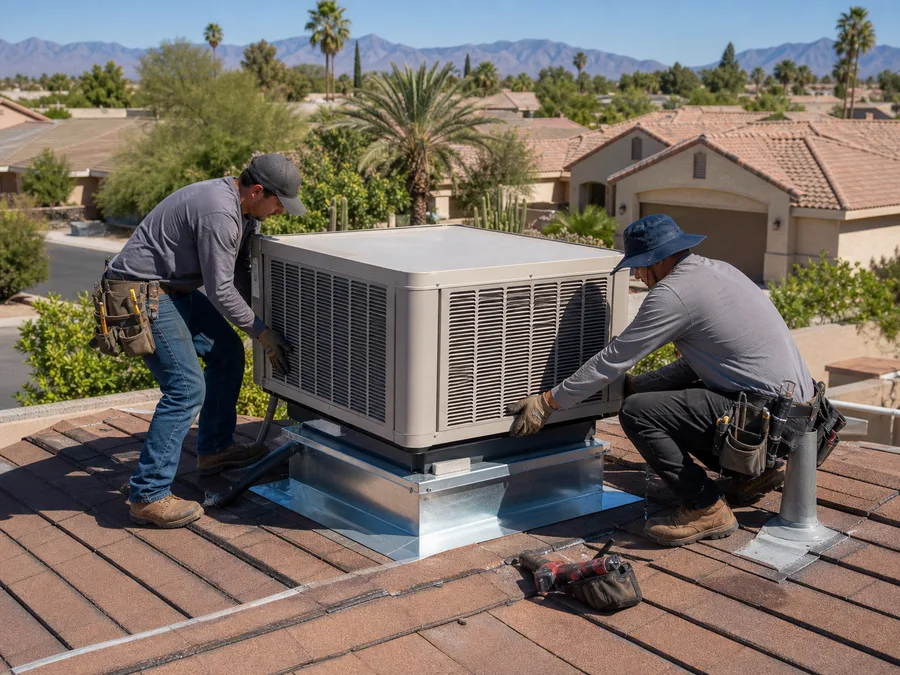
Some owners do on window or ground units by matching horsepower, speed, voltage, and shaft size. It involves wiring and belt alignment, so roof-mounted units and any wiring question are better handled by a technician.
Is it worth replacing the motor or the whole cooler?
A motor replacement often makes sense on a cabinet that is still solid. If the pan is rusted through, the cabinet leaks, or several parts are failing at once, compare the repair estimate with replacement.