Groundwater and Colorado River water can leave mineral deposits when water dries inside the cooler.
Local resources Tucson water and cooling guide
Why Tucson hard water causes mineral scale in home cooling systems
Tucson cooling problems are not only about heat. Local water quality, long run times, and mineral buildup can change how evaporative cooling pads, water lines, and reservoirs behave during the season.
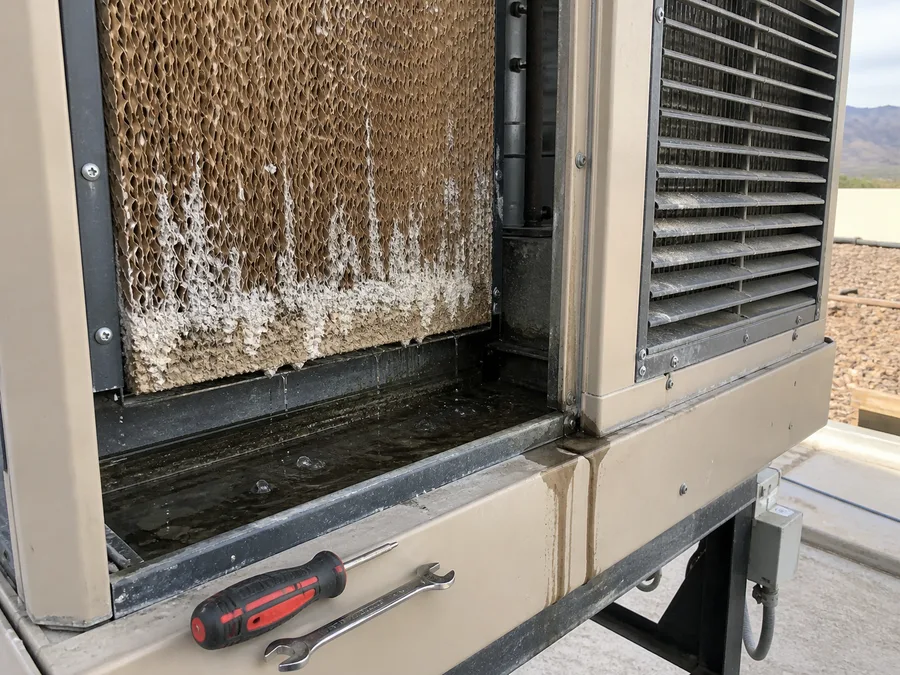
Hard-water minerals are a practical clue when pads crust over or water lines clog.
A longer season gives pads, lines, and the reservoir more time to collect buildup.
Dry heat can work well for evaporative cooling when water flow and airflow stay strong.
Hard water can turn a simple cooling system into a pad and water-flow problem.
Evaporative coolers depend on water spreading evenly through pads while the fan pulls dry air through them. In Tucson, hard-water minerals can leave white scale on pads, distributor lines, and the reservoir. When enough buildup collects, the cooler may still run, but the pads may not stay wet evenly.
Why Tucson water matters inside a cooler.
Tucson's water supply includes recovered Colorado River water delivered through the Central Arizona Project, recharged in Avra Valley, and recovered through wells, blended with local groundwater in a hard-water desert system that can leave mineral scale on pads and water lines. When that water evaporates inside the cooler, minerals can stay behind. Over time, the deposits can collect on pads, water distribution lines, louvers, and the reservoir.
If you see white crust, dry pad sections, or weaker airflow, mineral scale is worth checking along with the pump and water distribution.
What scale can change
Small water-flow problems can feel like one big cooling problem.
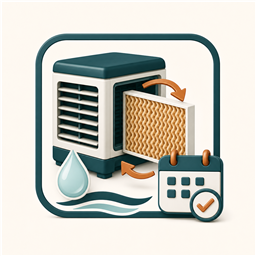
Pads may stop wetting evenly
Mineral scale can make parts of the pad crusty or blocked. The fan may still run while the air feels warmer than expected.
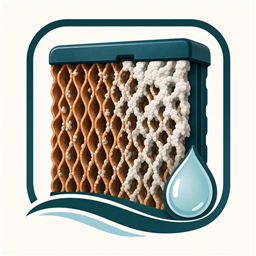
Distributor lines can clog
Small water passages across the top of the cooler can collect deposits. One side of the pad may stay dry even when the pump runs.
Airflow can feel weaker
A scaled or dirty pad can restrict air movement, making the problem feel like a fan issue.
Reservoir buildup can bring problems back
Scale in the pan or reservoir can make water-flow trouble return faster after cleaning or pad replacement.
Before you ask for help
What to notice without taking the cooler apart.
You do not need to know the exact repair. Just share what you can safely observe from ground level or from normal access points.
- White crust on pads, water lines, louvers, or the reservoir
- Pads that look wet in one area and dry in another
- Warm air during long afternoon run times
- Weak airflow even though the fan is on
- A pump that runs but does not seem to move enough water
- Scale returning soon after a cleaning or pad change
When to call
If the cooler is already struggling, ask for Tucson swamp cooler help.
Call or request an estimate if the cooler is blowing warm air, leaking, losing airflow, or leaving parts of the pads dry.
Tucson hard water and cooler scale questions.
Does Tucson hard water mean my cooler is broken?
No. Hard water is a local condition, not a final answer about your cooler. It simply means mineral scale may be one of the first things to mention when pads clog, water lines block, or cooling feels weaker.
Can mineral scale make a swamp cooler blow warm air?
Yes. If scale blocks water flow or keeps pads from getting wet evenly, the fan can keep running while the air feels warm. Pads, pump, distributor lines, and the reservoir are all worth mentioning when you ask for help.
Should Tucson homeowners replace pads more often?
Pads should be checked more often during heavy use in hard-water conditions. The right timing depends on the pad type, water flow, and how much visible mineral buildup the unit collects.
Check the local water and climate information.
Use these utility, climate, and permit sources to understand Tucson conditions before asking about scale, pads, water flow, or a larger replacement job.